
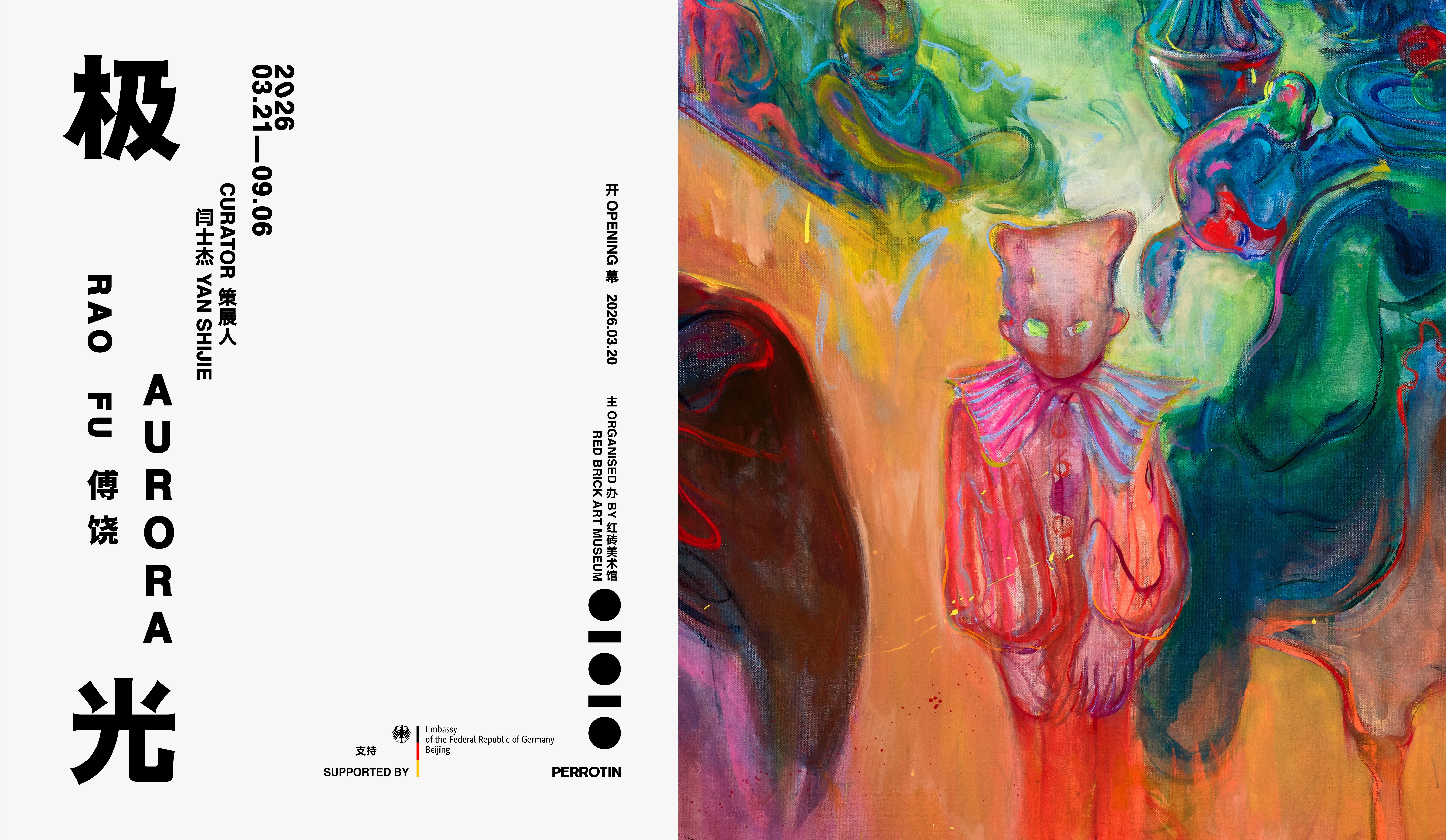
Rao Fu: Aurora
2026.03.21 - 2026.09.06
Denn still sind die Boten des Göttlichen
— Friedrich Hölderlin
Red Brick Art Museum will present the major solo exhibition Aurora by Chinese artist Rao Fu, on March 21, 2026. Curated by Yan Shijie, the museum’s founder and director, this exhibition marks Rao Fu’s most comprehensive and largest-scale presentation in China to date. It comes after his 25-year journey of study, life, and artistic creation in Dresden, Germany, since 2001, and offers a thorough survey of his artistic trajectory.
Featuring his monumental “Decalogy” series as its core, the exhibition will present over fifty works, including oil paintings and works on paper. Through a profound integration of painting with architectural space, it invites viewers into a contemplative journey concerning human existence, civilizational migration, and the dwelling of the soul.
Aurora: Illuminating from the Fracture
“Aurora” is the miraculous light that erupts in the coldest, darkest peripheries of our planet. Rao Fu, situated at the intersection of Eastern and Western cultures and amidst the intense upheavals of global turmoil and personal displacement, has consistently used the canvas as his field of action, choosing to “illuminate from the fracture.” As he himself states: “Light is silent, yet it reveals—painting is a silent epiphany.”
As a Chinese artist who has long resided in Germany, Rao Fu arrived in Dresden in 2001, where, on the banks of the Elbe River, he began to interrogate another spiritual tradition. He absorbed the German Romantic reverence for the divinity of nature and the Expressionist courage to reach the abyss through color. Between Edvard Munch’s anxiety, Peter Doig’s dreamlike ambiguity, and Daniel Richter’s visual alchemy, Rao Fu found his own “magic triangle.”
His painting presents a rare form of dual writing. Behind his brilliant colors and seemingly wild Western Expressionist landscapes, one senses an Eastern breath—figures, landscapes, architecture, and space are imbued with the linear articulation and flowing spirit-resonance (qi yun) of Chinese landscape painting. At times, the human figure dissolves into the landscape; at others, the landscape itself writes the human spirit. Themes of fate, migration, displacement, and identity—constantly shifting—transform into a mysterious, dramatic, philosophical, and poetic visual symphony.
His twenty-five years in Germany have not been a simple overlay of Eastern upbringing and Western immersion, nor of his parallel studies in philosophy and art psychotherapy. Instead, they have been a continuous process of collision, dialogue, rejection, and fusion. Those enigmatic figures with hollow eyes and his intensely vibrant colors are his path inward, a silent freedom.
Poetically Dwelling
“…poetically man dwells upon this earth”—this maxim from Friedrich Hölderlin’s late hymn “In lovely blueness…” has been the deep driving force behind Rao Fu’s artistic exploration since he first encountered it in 2009. It has become the very ground of his artistic spirit, and his creative practice is a direct embodiment of this proposition.
This exhibition will, for the first time, present together the eight completed works (of a planned ten) from his “Decalogy” series, which he began in 2016. These monumental triptychs, each over four meters wide, construct a “film to be viewed in the round,” recording countless trajectories of life and spiritual landscapes, and profoundly showcasing the artist’s unique exploration of the folds of Eastern and Western cultures.
The opening works, Light Year (2019) and Loosed String (2019), establish the spiritual tone of the “Decalogy.” The former, as Rao Fu describes it, is a beam of light “that has passed through my body, straight toward the firmament,” pointing to a pure existence that transcends time, space, culture, and national borders. The latter is like a horizon torn apart by tension, overlapping the individual experience of departure with the historical collisions of our era, marking a shift from being “enveloped by the landscape” to “constructing meaning through the landscape.”
The subsequent works, Abyss I (2020) and Abyss II (2022), are not traditional landscapes but “mental topographies” layered from memory, imagination, and history. With wild brushstrokes, antagonistic colors, and profound fissures, they present the individual’s loss and reflection within grand historical narratives, echoing the German Romantic tradition of Friedrich’s “contemplation of the back-turned figure.”
Legend (2021) uses the whale as a metaphor for his own state of drift and his longing for cross-cultural freedom, while The Sound of Wind (2022) condenses the trauma of migration and the complex tensions of global ethics beneath a deceptively calm seascape. His latest work, Mirage (2023), responds to the historical metaphor of contemporary global migration through a mythologized ocean, and The Night Banquet (2023) constructs a spiritual ritual amidst chaos, with giants holding sacred objects and night-walkers, like Dionysian priests awakening humanity’s yearning for clarity in the darkness.
The exhibition will also feature a significant body of Rao Fu’s representative works on paper, which fully continue the modeling and Expressionist color traditions of the Dresden School. This includes watercolors created in early 2026 during his visit to Edvard Munch’s house in Warnemünde, Rostock, northern Germany. For Rao Fu, these works on paper are not sketches or exceptions to his oil paintings, but a continuous part of his painting practice. Even away from his studio, he often writes down thoughts, inspirations, and visual impressions at home, making these drawings a kind of visual diary where memory and reflection are directly interwoven.
As German art historian Tereza de Arruda notes, “Rao Fu’s artistic development is not a linear inheritance of Western influence, but the result of a complex interaction between contemporary Chinese art, the German academic tradition, and personal experience. His position reflects the reality of the globalized art world: geographical labels are increasingly relative, and as a cross-cultural medium, he no longer makes explicit statements, but subtly integrates universal questions into the background of his work.”
Rao Fu’s creation elevates personal experience into a profound contemplation of the universal human condition. His canvases often feature ghostly figures with blurred outlines and empty eyes—nameless, without origin or destination—yet they carry the collective trauma of war, migration, and displacement. Juxtaposed with these figures are magnificent yet uncanny landscapes that are not geographically real, but are transformed into inner landscapes where the soul can dwell and reflect—a contemporary visual echo of Hölderlin’s call for “poetic dwelling.”
A Spiritual Homecoming Across Two Centuries
For Rao Fu, the exhibition “Aurora” is his own “homecoming” (Heimkunft), akin to Hölderlin’s. In his view, painting is not merely a carrier of images but a vessel for the soul. He treats the entire exhibition hall as an “enterable canvas,” extending the language of painting into architecture. The space has been transformed into a vertically structured spiritual edifice with a strong sense of ritual: visitors must ascend a staircase, passing through layers of curtains woven from color and light, to finally reach the “inner sanctum” at the top. This upward path symbolizes the arduous climb of the spirit, while the quiet sanctum represents the inner order and poetic dwelling that humanity can still find in turbulent times.
As German art historian Katharina Arlt observes, “Rao Fu’s work reminds us that true painting is not about producing images, but about reawakening the ‘seeing soul.’ It is the last remaining glimmer of light that humans can hold onto beyond the light of technology: the warmth of the hand, the rhythm of breath, and a sincerity that cannot be datafied.”
Rao Fu consistently rejects simplistic narratives or symbolic expressions. While questioning the present, he also embeds a glimmer of hope and strength from the depths of his heart into the depths of his paintings. As he once said in an interview, “Painting is my way of resisting nihilism, and the starting point for my soul to find a home.”
If Hölderlin was the prophetic poet of the modern predicament, Rao Fu is the visual practitioner of this long spiritual journey in the age of hypermodernity. In an era saturated with images yet devoid of meaning, where artificial intelligence simulates “creation” through algorithms, his painting is a spiritual homecoming mediated by color, line, and space—not a physical return to one’s homeland, but a summoning of light from the periphery of darkness, a return to the spiritual “original home.”
“Rao Fu’s ‘Aurora’ is born from the night of displacement, yet it points toward a shared spiritual homeland,” says curator Yan Shijie, who describes Rao Fu as a “visual practitioner” of our time: “On the ruins of hypermodernity, he has ignited a light with the immediacy of painting, answering the question that has persisted since the dawn of modernity—how can man still dwell poetically upon this earth?—and inviting us to complete our own spiritual homecoming through the act of seeing.”
——————
Rao FU
Born in Beijing, 1978. Lives and works in Dresden and is a cross-cultural artist active within the contemporary German painting scene. His work is deeply rooted in both Eastern and Western cultural traditions, creating a highly charged visual language that balances the spiritual foundation of Eastern painting with the structural materiality of Western practice. Growing up in a rational and scientific family environment, he ultimately turned to art, beginning a lifelong exploration across Chinese and German cultural contexts.
In 2001, Rao Fu moved to Germany to study at the Dresden Academy of Fine Arts, where he has lived and worked for over two decades. His practice continues the pedagogical lineage of the Dresden School. Influenced by the German Romantic poet Friedrich Hölderlin, particularly the notion of “poetically dwelling”, he explores spiritual and existential dimensions in his work. Rao Fu’s work focuses on global themes such as refugees, war, and migration, reflecting on rupture, reconstruction, and identity formation. His interdisciplinary background—holding dual master’s degrees in Fine Arts and Art Therapy—further informs his engagement with the structure of the psyche and existential experience. Rao FU’s sustained cross-cultural practice has established a distinctive position in contemporary painting, combining conceptual depth with visual intensity.
Rao Fu has received numerous awards, including Project Funding “Denkzeit” and the “Spielerei Leipzig” Scholarship from the Cultural Foundation of the Free State of Saxony; the Artist Scholarship from the Heinrich-Böll-Foundation; and the DAAD Award for Outstanding Achievements by Foreign Students and the DAAD Prize from the German Academic Exchange Service (DAAD). In 2014, he was recognized as an Outstanding Young Artist of the Free State of Saxony and published his first monograph Follow Wind, supported by the Volkswagen Art Foundation. In 2022, he was included in the survey publication Dissonance – Platform Germany, establishing his position within the contemporary German painting context. His works are held in major institutional collections, including the Staatliche Kunstsammlungen Dresden (SKD), Städtische Galerie Dresden, National Museum of History and Art Luxembourg (MNAHA), Milwaukee Art Museum, and Deji Art Museum. In 2025, he participated as one of the representatives of contemporary German art in the opening exhibition of the German Pavilion at Expo Osaka.
————
Yan Shijie
Yan Shijie is the founder, director and curator of the Red Brick Art Museum, a pioneer in proposing and implementing the concept of “ecological museum experience” in China.
In 2025, he presented the exhibition “Chiharu Shiota: Silent Emptiness”, followed in 2024 by “Tomas Saraceno: Complementarities”. Earlier projects include “Heidi Bucher: Beyond the Skins” (2023) and the project “Xu Bing: Art Beyond the Kármán Line”(2021), which explored the intersection of contemporary art and aerospace technology. In 2020, Yan Shijie curated the large international group exhibition “2020+”, attempting to open a multi-dimensional space for understanding the pandemic, public crises and social upheavals that have blanketed the globe. In 2019, he curated Sarah Lucas’ largest eponymous solo exhibition in Asia, “Sarah Lucas”. In 2018, Yan Shijie was the curator of “The Unspeakable Openness of Things”—the largest solo exhibition of Olafur Eliasson in China to date. In 2016, he curated the exhibition “Identification Zone: Chinese and Danish Furniture Design” which was the first design-centered dialogue between Chinese classical furniture and Danish furniture masterpieces. Other well-received exhibitions curated by Yan Shijie include the first solo exhibition in China of the American artist, “James Lee Byars: The Perfect Moment” (2021), “Izumi Kato”(2018), “Andreas Mühe: Photography”(2018), “Andres Serrano: An American Perspective”(2017) and ‘Wen Pulin Archive of Chinese Avant-Garde Art of the 80s and 90s”(2016). The aforementioned exhibitions have constructed deep and multi-dimensional explorations and reflections on contemporary art from various perspectives.
极光
Aurora
策展人: 闫士杰
Curator: Yan Shijie
艺术家: 傅饶
Artist:Rao FU
展期:2026年3月21日至9月6日
Dates: March 21– September 6, 2026
主办: 红砖美术馆
Organised by Red Brick Art Museum
支持 :德意志联邦共和国驻华大使馆、贝浩登画廊
Supported by
Embassy of the Federal Republic of Germany, Beijing
PERROTIN


