
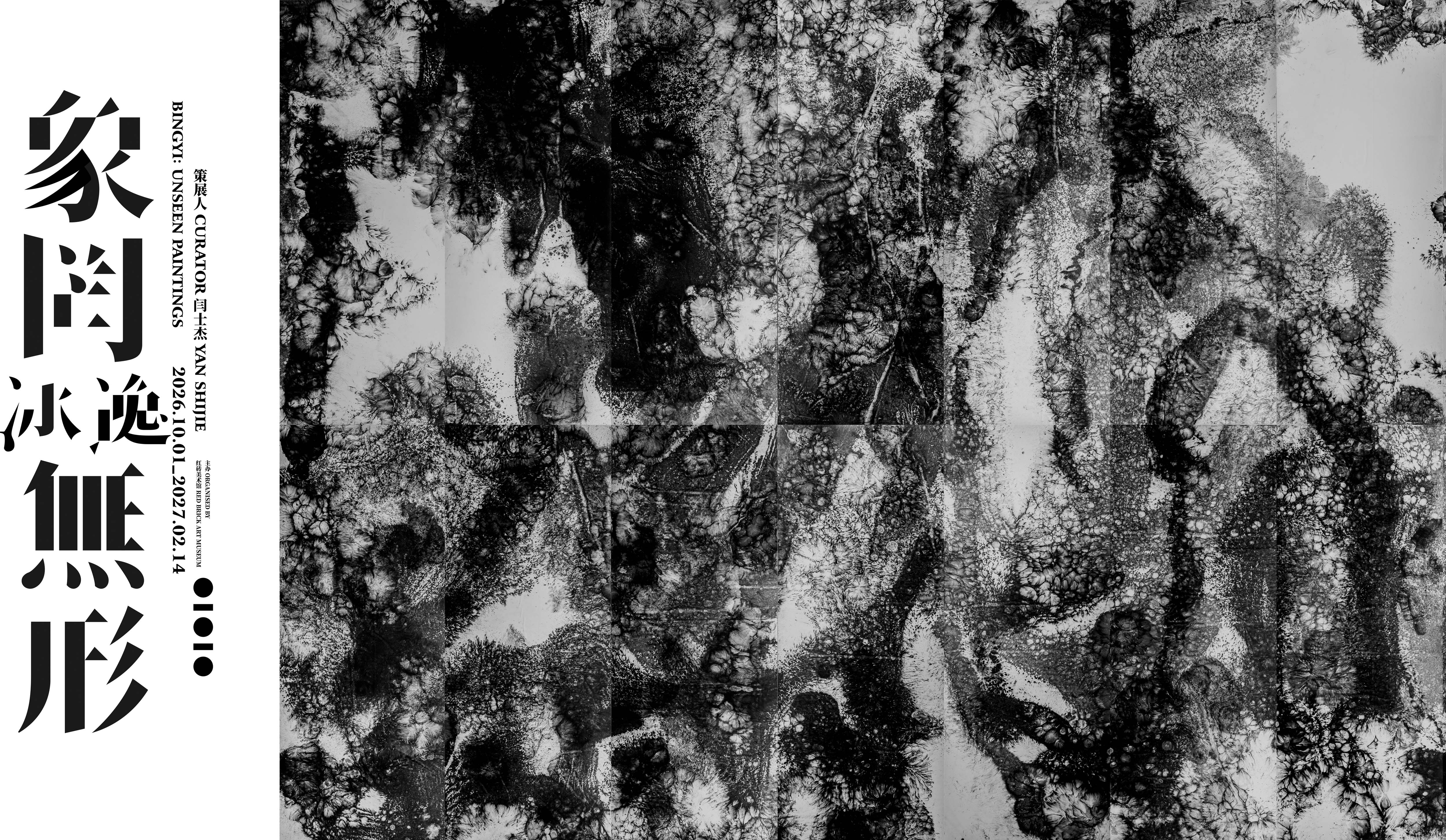
冰逸 · 象罔无形
2026.10.01 - 2027.02.14
冰逸·象罔无形
Bingyi:Unseen Paintings
策展人: 闫士杰
Curator: Yan Shijie
艺术家: 冰逸
Artist: Bingyi
展期:2026年10月1日至2027年2月14日
Dates: October 1,2026– February 14, 2027
主办: 红砖美术馆
Organised by Red Brick Art Museum
The human worldis ultimately troublesome.Whereas nature has the highest form of wisdom and intellect. Nature’s scale is either too bigor too small for humans. Once it is beyond the human scale, we’re back to nature. I create shan shui and land paintings in nature.
— Bingyi
Red Brick Art Museum presents Unseen Paintings—the largest solo exhibition of Bingyi to date, curated by Yan Shijie. The exhibition systematically surveys the trajectory of Bingyi’s practice over the past two decades since 2008, presenting monumental ink installations, the Earth and Climate series, speculative archaeological narratives, and Talismans series. The majority of the monumental works are on public view for the first time.
From Scholar to Artist
Bingyi grew up in the mountains, running daily across the great rock face of the Jingshi Yu at Mount Tai as a child. Her grandfather, a professor of economics at Peking University, steeped her in classical culture. At nineteen, she entered Mount Holyoke College in Massachusetts to study art history, and went on to earn a Ph.D. in art history from Yale University. Her dissertation, centered on the Mawangdui finds, re-examined the transformation of Chu culture into the visual and ideological systems of the Western Han. She interned at the Museum of Fine Arts, Boston, cataloguing its collections and gaining access to numerous original masterworks of ancient Chinese painting.
In 2008, curator Okwui Enwezor included Bingyi’s paintings in the 7th Gwangju Biennale—never having received fundamental training in painting, Bingyi thereby began her turn from scholar to artist. In 2009, commissioned by Wu Hung to create Cascade, she began working with ink as her medium.
A Critical Transformation of “Learning from the Ancients”
Bingyi is among the very few contemporary Chinese artists to have received rigorous Western academic training with Chinese art history as her field of research. Scholar and artist breathe as one in her—A Treatise on Shanshui Painting and her artistic practice are mutually sustaining. This academic background determines her understanding of “tradition”: not as an aesthetic style, but as a process of knowledge production and power construction.
The Taihang series returns to the spiritual birthplace of Chinese shanshui painting—where Jing Hao wrote Bifa Ji (Notes on Brushwork) and Fan Kuan, Guo Xi, and Li Tang established the paradigm of Northern Song shanshui painting. Bingyi consciously “return to the site” to learn from the ancients, not for imitation or repetition, but to ask: if Fan Kuan were alive today, how might he face the contemporary crises of ecology, the politics of gender, and historical anxieties?
She conceived a Northern Song female master ,”Hua”, and a lost “Lotus Dynasty” to create a speculative archaeology of women’s art history , fabricating a full set of “evidence” for this parallel civilization: stelae, diary, charters, imperial seals, genealogies, archaeological documents and paintings—a veritable archaeological site. The writing of art history is an act of power in itself; “Hua” is a wake-up call.
Not Painting Nature, but Letting Nature “Paint”
Bingyi pushes “learning from nature” to its limit: letting wind, water, humidity, gravity, gradient, seepage, and time enter directly into making of the paintings. Nature is no longer an object to be depicted, but a co-author of painting.
Cascade (2010) was made back at Mount Huang, on a basketball court in Xiuli Village, Anhui: roughly 20×13 meters of xuan paper spread across the ground, Bingyi and her assistants working at night by car headlights, splashing and pouring ink mixed with household detergent again and again. The ink’s seeping, diffusion, and drying—these physical processes themselves constitute the picture. This is not a “depiction” of water; it is water’s self-portrait.
Wanwu:Metamorphosis (2010–2013) was created at Longhu Mountain, the ancestral seat of Taoism: six custom-made ink paintings on xuan paper, each approximately 22×2.8 meters, exploring the manifestations of natural forces at microscopic and macroscopic scales. Shape of the Wind (2012), on the banks of the Fuchun River, records in a scroll over 200 meters long how wind sculpts ink, constructing a visual mapping of time, distance, and dissolution.
Epoché (2014) drops one ton of ink from a helicopter; the explosive traces imprinted at the instant of impact record the complete physical process of gravity, velocity, and shock—painting becomes an aerial act, a gravitational event, a public spectacle.
Emei Waterfall (2018) makes gravity the brushstroke on a 200-meter-high dry cascade at Mount Emei, the Buddhist sacred mountain—Bingyi brings her concern for ruins back into the mountains: with one ton of ink she re-creates the long-dried waterfall, letting it fall again, growing forth a genuine resonance between heaven and earth.
Over the past two decades, Bingyi takes an almost project-management-like approach to her creations. She knows well that “each project has a life of its own.” A scholar’s distinctive methodology thus sets artistic practice in motion.
Each process of venturing into the mountains, selecting a site, making observations, documenting, and waiting is like a complete project in field research; Each mountain becomes an independent exploration and experimentation.
From Microscopic Life to Talismanic Energy
Since 2010, Bingyi has copied sutras daily in small regular script; the fine-line paintings of Fairies grew out of this practice, turning from macroscopic landforms toward microscopic life. Nearly one hundred round fans (34 cm in diameter) depict spores, sinews, tendrils, and hairs with extreme delicacy—seemingly biological, seemingly mineral, seemingly nebula.
She takes the concrete objects at hand—a teapot, a fallen leaf, a spider hanging from a tree, a scholar’s rock on her desk—and renders them into poetic and spiritual forms. The compositions are small enough to hold in one’s palm; the brushwork is too fine for the naked eye to resolve. Every line emerges from the tacit rhythm among the heart, hand, brush, ink, and paper, honed through years of sutra transcription—”only when vision recedes can we perceive what is outside of the painting.”
Talismans carries this energy aesthetics toward the spiritual dimension. Created at Longhu Mountain, the Taoist sacred site, Bingyi moves breath through qi and invokes through chant, producing “the writing of ritual action.” Talismans were originally the secret script by which Taoist rites communicated between heaven and earth, summoning gods and subduing demons; Bingyi “translates” them from their religious context into contemporary painting—those coiling lines, layered ink, and ritual compositions become the visualization of energy, pursuing a more primal, more corporeal spiritual experience: connecting human beings with nature, and invisible forces.
“How can Chinese artists, standing within the field of their time, look across East and West, rely on a multidimensional knowledge system, observe, practice, and gain the insights necessary to construct a shanshui philosophy and art for this era?” The question posed by curator Yan Shijie is perhaps the most urgent inquiry facing art today.
————
Artist
Bingyi, born in Beijing and educated in the United States, received her Ph.D. in art history from Yale University in 2005 where she specialized in the literature and culture of the Han Dynasty. There, she developed her ability to compose texts in various classic formats whether in ancient shijing-style poetry, rhapsodic fu-style verse or ancient guwen-style prose. This laid a profound literary and intellectual foundation for her future artistic practice.
Bingyi’s journey from scholar to artist began in 2008 when she met the international contemporary art curator Okwui Enwezor who subsequently curated Bingyi’s ink-inspired monumental pencil drawings into the 7th Gwangju Biennale. That same year, Xu Bing curated Bingyi’s oil paintings as part of her New York debut at Max Protetch Gallery. Curator Gao Minglu subsequently selected Bingyi’s ink-inspired oil painting for inclusion in his seminal “Yipai” exhibition at the Today Art Museum in 2009. Wu Hung, through Okwui’s introduction, then commissioned Bingyi’s first monumental, “land-and-weather” ink painting for installation at the Smart Museum of Art at the University of Chicago in 2010. Since then, Bingyi has gone on to work closely with multiple leading curators such as Britta Erickson, Susan Benningson, Hiromi Kinoshita, Leeza Ahmady, Jan Stuart and, most recently, with Susanna Ferrell and Michael Govan at the Los Angeles County Museum of Art.
Bingyi’s exhibitions at major international art institutions include: the National Museum of Asian Art (2026) and Harvard Art Museums (2025). Her works has exhibited internationally at the Asia Society Hong Kong Center (2026), Morgan Library & Museum (2025), China Institute Gallery (2025), Space & Gallery Association (SGA, 2025), China Institute (2025), Los Angeles County Museum of Art (2021, 2024), Philadelphia Museum of Art (2022-2023), Art Basel Hong Kong Encounters (2022, 2017), the Brooklyn Museum (2019), the National Art Museum of China (2017), Shanghai Museum of Contemporary Art (2016); Istanbul Modern (2016); Museo de Arte Contemporaneo de Alicante, Alicante, Spain (2014), St. Johannes-Evangelist-Kirche, Berlin, Germany (2012), Smart Museum of Art, University of Chicago, Chicago, USA (2010), Galerie Erna Hecey, Brussels, Belgium (2009), Contrasts Gallery, Shanghai, China (2009), and Max Protetch Gallery, New York, USA (2008). Her works have also been included in “Surveyor”, Albright-Knox Art Gallery, Buffalo, USA (2011), and “Yipai—Century Thinking”, Today Art Museum, Beijing, China (2009), and featured in “The 7th Gwangju Biennale,Annual Report: A Year in Exhibitions”, Gwangju, South Korea (2008).
Bingyi’s works are collected widely by museums and privates, including the Los Angeles County Museum of Art, Los Angeles, USA; White Rabbit Contemporary Chinese Art Collection, Sydney, Australia; Art Institute of Chicago, Chicago, USA; the Smart Museum of Art, University of Chicago, Chicago, USA; Philadelphia Museum of Art, Philadelphia, USA; Brooklyn Museum, New York, USA; Mount Holyoke College Art Museum, MA, USA; Yale University Art Gallery, New Haven, USA; National Museum of Asian Art, Washington, D.C., USA; Museo de Arte Contemporaneo de Alicante, Alicante, Spain; and Museum of Chinese Women and Children, Beijing, China.
Read all


