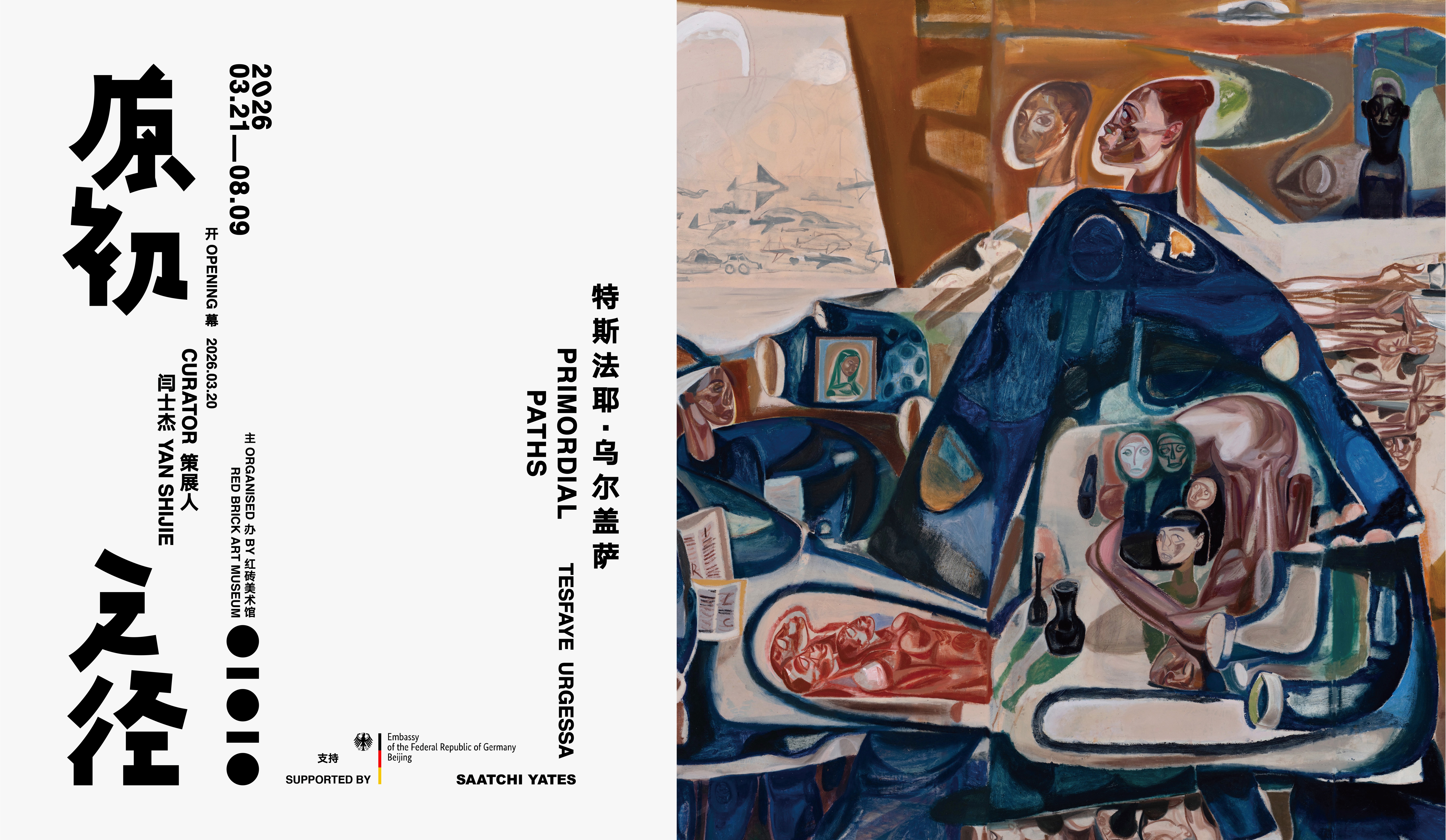
TESFAYE URGESSA: PRIMORDIAL PATHS
2026.03.21 - 2026.08.09
“To me, surviving such challenges is resilience. Presenting oneself with all weaknesses and all the weight of past experiences openly, responsibly, and with confidence is an act of dignity.”
— Tesfaye Urgessa
Red Brick Art Museum will present Tesfaye Urgessa: Primordial Paths On 21 March 2026, a major solo exhibition by Ethiopian artist Tesfaye Urgessa (b. 1983, Addis Ababa), curated by Yan Shijie, Founder and Director of Red Brick Art Museum. Marking Urgessa’s first museum exhibition in Asia and his most comprehensive international solo presentation since representing Ethiopia at the 60th Venice Biennale in 2024, the exhibition will systematically survey the artist’s practice since 2019, bringing together over sixty works—including oil paintings, works on paper, and selection of archives s—to unfold Urgessa’s sustained reflections on migration, displacement, and questions of racial and cultural identity.
Primordial Paths does not point to a traceable historical origin or mythic source, but rather to a temporal depth continuously unfolding in the present. As Urgessa states: “My mission is to observe, record, and present the world as I see it, taking on the role of an eternal observer.” In the context of movement and displacement, “primordial” becomes an inner echo rather than a beginning; “paths” suggest both movement and divergence, process and labyrinth, process and labyrinth. Through layers of memory, identity, and subconscious, progress is always a dialogue with the primordial. Hidden, submerged, and unspoken traces quietly chart the direction of our journey——and the primordial has not receded , it remains within us, each step forward carrying its weight and warmth.
Homeland and Elsewhere: The Tension of Identity as Creative Ground
Born in Addis Ababa in 1983, Urgessa received his earliest artistic inspiration from church murals; the ritualistic solemnity of religious imagery was deeply embedded in his childhood visual memory. In 2009, he moved to Germany to study at the Staatliche Akademie der Bildenden Künste Stuttgart .These layered influences converge in a practice that merges Ethiopian and Western traditions into a distinct contemporary language.
Over thirteen years of living and working abroad, Urgessa has confronted racial discrimination and witnessed the European refugee crisis. These experiences deepened his concern for structural injustice and the plight of the displaced. In 2022, he returned to Ethiopia with his family. During this period, global unrest intensified. The turbulence of the world compelled him to confront the essence of humanity. Since then, his work has expanded beyond personal experience to engage with broader human conditions. “The distance between homeland and elsewhere is no longer merely spatial—it carries the tension of identity and culture.”
In his paintings, interior and wilderness, homeland and foreign land, memory and the present coexist and fold into a single plane, generating a unique and vital presence: ochre and deep green carry the warmth of home, while deep blue and black embody the weight of displacement. Those seemingly frozen bodily postures are in fact imbued with unfinished gestures.”Tesfaye Urgessa seems to represent verbs rather than subjects. In fact, his paintings appear to embody and actualise semantic families of verbs with a deep collective and experiential meaning for humankind.” said Eike D. Schmidt, former director of the Uffizi Gallery, Florence.
A Layered Journey Through Memory, Identity, and the Subconscious
The exhibition Primordial Paths unfolds across four thematic sections, constructing a progressively immersive viewing path:
Tracing the Practice opens with a self-portrait and presents key paintings and works on paper from 2019 to 2025, shown alongside archival materials and documentary screenings. Viewers can clearly trace how Urgessa transformed domestic space(such as Fever 2)—beginning in the living room—into a point of departure: movement starts at home, then extends outward into the world. It is precisely within these tangible, lived-in environments that the figures’ tension and vitality emerge.
No Country for Young Men brings together six large-scale paintings from Urgessa’s ongoing series initiated in 2016 during the height of the European refugee crisis. Deeply affected by news footage of migrants crossing the Mediterranean Sea, the artist focused on the motif of the foot—both literal and symbolic—as a meditation on displacement. This exhibition for the first time presents six large-scale works created between 2020 and 2024, in the scenes depicted, figures move within yet cannot escape, suspended in unresolved tension. In dialogue with this body of work, the Head Portraits series compresses collective histories into the intensity of a single gaze—folding questions of memory, presence, and existence into one face.
Human Conflicts and Resilience extends the concerns of Urgessa’s 2024 Venice Biennale exhibition Prejudice and Belonging. Works confront the fractures caused by global conflict: in Spring or Fall (2024), a floating spatial structure mirrors the oscillation between hope and loss; in Hear No Truth (2023), a bottomless black sea, drifting feet, and empty boats frame three figures embracing a childlike form between life and death. This section also features the Leap of Faith series—in Leap of Faith 2 (2025), two figures stand in a tight embrace, intertwining motherhood, domestic objects, and identity into a gesture of mutual reliance.
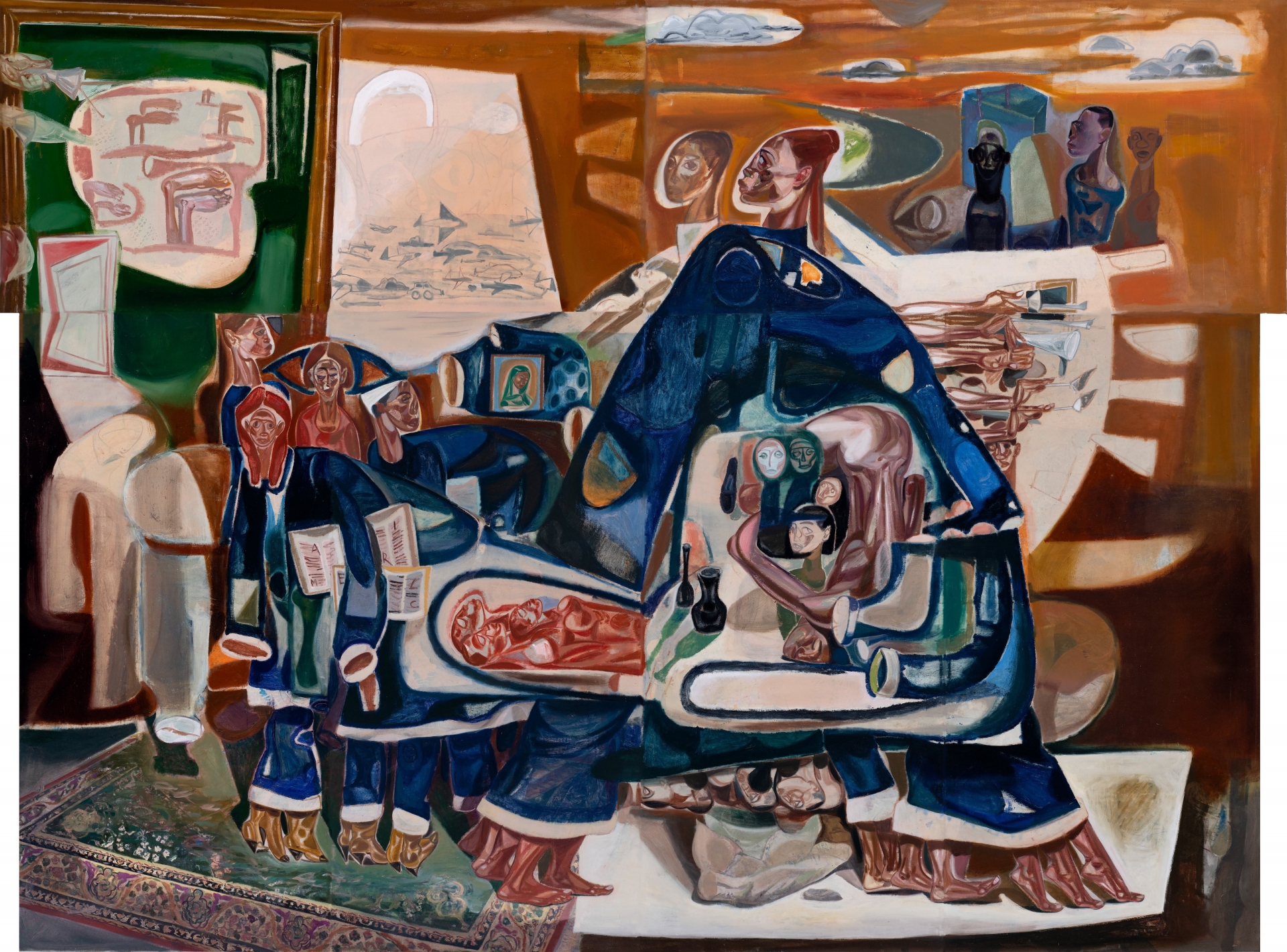
At the heart of the gallery is the monumental hexaptych The Dormant Dream (2025–2026), created specifically for this exhibition. Inspired by Urgessa’s observation of the collective movement in Chinese traditional lion dance—where countless bodies uphold a single form—the painting gathers layered footsteps, a backward-looking female figure, and dormant red bodies into a grand composition. Domestic space, migrating steps, institutional clouds, and distant trajectories converge to propose: progress is not a leap detached from the past, but an unfolding through bearing. Moving forward and looking back coexist; strength germinates in what is quietly borne.
In First Flame (2024–25), a world in flux unfolds against the backdrop of global conflict; a maternal figure raises a small plant, symbolizing care and regeneration. In Skin (2025), turbulence turns inward: a standing figure in a deep blue skirt anchors a fractured interior, holding instability in balance. In the context of ongoing global upheaval, these paintings construct a spiritual space that holds compassion, summons memory, and reasserts shared vulnerability. Here, resilience does not mean the denial of wounds, but the choice to continue despite them.
Lost Land constructs a spiritual landscape marked by recurring deep green terrain. The maternal figure emerges as a central presence, catalyzed by a documentary about an Ethiopian mother who migrated through Sudan to settle in Germany. In Mother 2 (2025), she kneels and leans forward, enveloping her child, her gaze extending beyond a window that signifies a leap of faith. In Gold Dust (2025), she cradles her child while gazing at a framed photograph—the figure becomes both mirror and threshold. Here, “lost” does not refer to a specific territory, but to identities, languages, and emotional terrains displaced and renamed through movement. Suspended between memory and lived reality, the maternal figure stands as an emblem of renewal—affirming that continuity persists even amid rupture.
Epilogue: How Do We Live?
“How do we live?”—this question, threading through Urgessa’s recent practice, is also the one he poses to viewers through this exhibition. Amid intersecting crises of conflict, displacement, climate emergency, and individual struggle, he offers no solutions, but instead presents the vulnerability and resilience of the human condition through painting. Life thus becomes an ongoing process—borne, transformed, and quietly unfolding through our shared sustenance.
Yan Shijie, Director of Red Brick Art Museum and curator of the exhibition, notes: “As a significant representative of the rising cultural force of the Global South, Ethiopian art is gaining increasing international attention. Urgessa, alongside compatriots such as Julie Mehretu, Maaza Mengiste, and The Weeknd, constitutes an undeniable cultural wave. Ethiopia’s debut pavilion at the 2024 Venice Biennale, entrusted to Urgessa, marked the country’s formal entry into the mainstream of global contemporary art. Yet Urgessa does not stop at personal narrative. Last summer, he organized a group exhibition in Germany for several young Ethiopian artists and actively worked on establishing an artist residency and education center in Addis Ababa, demonstrating a long-term commitment to nurturing local artistic ecosystems—a sense of responsibility that resonates deeply with his artistic practice. Primordial Paths speaks of movement and bearing, of future and echo. With a highly charged visual language, Urgessa opens for us a distinctive perspective through which to understand the fate of contemporary humanity.”
————
Thank you to Saatchi Yates gallery and all the lenders from across the world who made this exhibition possible. We extend our thanks to AMOCA Wales; Cheng-Lan Foundation; Cc Foundation; Eclosion Collection + Projects, Beijing; Hskin Art Salon; Louisiana Channel, Louisiana Museum of Modern Art; Sainsbury Centre, University of East Anglia, UK and other private collectors from China, Europe, and the United Kingdom.
——
Tesfaye Urgessa, born in 1983, lives and works between Nürtingen, Germany and Addis Ababa, Ethiopia. He studied in Ethiopia before graduating from the Staatlichen Akademie in Stuttgart, Germany. Through these experiences, Urgessa developed a distinctive visual language that connects Ethiopian iconography with a deep interest in traditional figurative painting. His classically rendered figures, often shown with writhing bodies, convey a distorted psychological tension set within domestic spaces. Urgessa’s work explores complex themes of race and identity politics.
His painting is held in the permanent collections of Sainsbury Centre, Norwich, England; Brooklyn Museum, New York, United States of America; Zabludowicz Collection, London, England; Castello di Rivoli, Turin, Italy; Uffizi Gallery, Florence, Italy; Kunstmuseum, Stuttgart, Germany; Rubell Museum, Miami, United States of America; Staatsgalerie Stuttgart, Germany; The Museum of African Contemporary Art Al Maaden, Marrakech, Morocco; AMOCA, Wales and Cheng-Lan Foundation. In 2024, Tesfaye Urgessa was chosen to represent Ethiopia for their debut pavilion at the 60th International Art Exhibition — La Biennale di Venezia. In 2025, he presented his first UK institutional solo exhibition at the Sainsbury Centre. In 2026, he is presenting his most comprehensive solo exhibition to date at the Red Brick Art Museum in Beijing, China.
————
Yan Shijie
Yan Shijie is the founder, director and curator of the Red Brick Art Museum, a pioneer in proposing and implementing the concept of “ecological museum experience” in China.
In 2025, he presented the exhibition “Chiharu Shiota: Silent Emptiness”, followed in 2024 by “Tomas Saraceno: Complementarities”. Earlier projects include “Heidi Bucher: Beyond the Skins” (2023) and the project “Xu Bing: Art Beyond the Kármán Line”(2021), which explored the intersection of contemporary art and aerospace technology. In 2020, Yan Shijie curated the large international group exhibition “2020+”, attempting to open a multi-dimensional space for understanding the pandemic, public crises and social upheavals that have blanketed the globe. In 2019, he curated Sarah Lucas’ largest eponymous solo exhibition in Asia, “Sarah Lucas”. In 2018, Yan Shijie was the curator of “The Unspeakable Openness of Things”—the largest solo exhibition of Olafur Eliasson in China to date. In 2016, he curated the exhibition “Identification Zone: Chinese and Danish Furniture Design” which was the first design-centered dialogue between Chinese classical furniture and Danish furniture masterpieces. Other well-received exhibitions curated by Yan Shijie include the first solo exhibition in China of the American artist, “James Lee Byars: The Perfect Moment” (2021), “Izumi Kato”(2018), “Andreas Mühe: Photography”(2018), “Andres Serrano: An American Perspective”(2017) and ‘Wen Pulin Archive of Chinese Avant-Garde Art of the 80s and 90s”(2016). The aforementioned exhibitions have constructed deep and multi-dimensional explorations and reflections on contemporary art from various perspectives.
原初之径
Primordial Paths
策展人: 闫士杰
Curator: Yan Shijie
艺术家: 特斯法耶·乌尔盖萨
Artist:Tesfaye Urgessa
开幕: 2026年3月20日 (仅限邀请)
Opening: March 20, 2026 (Invitation Only)
展期:2026年3月21日至8月9日
Dates: March 21– August 9, 2026
主办: 红砖美术馆
Organised by Red Brick Art Museum
支持:德意志联邦共和国驻华大使馆、萨奇雅茨画廊
Supported by
Embassy of the Federal Republic of Germany, Beijing
Saatchi Yates